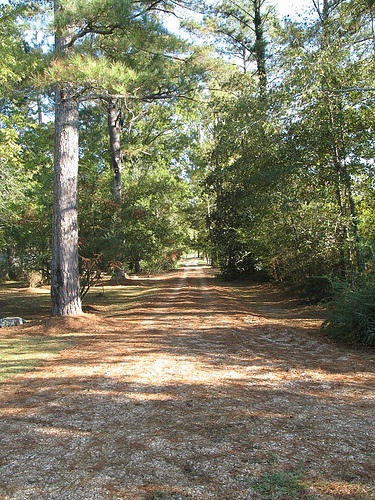
Lynwood Loved The View From Home
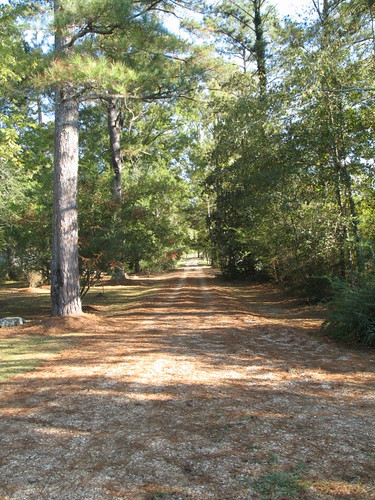
This is for Max. It chronicles the trip Ryan and I made to Lynwood’s funeral on Friday, October 26, 2007. This post first appeared on Max’s site, MaxMcAlister.com.
Ryan spotted a mullet-wearing old man with a guitar case while we were waiting to board a 7:45am American Eagle flight from D/FW to Jackson. Such scenes make for humorous times between me and Ryan. But quickly I spotted an older black man and asked Ryan, “Do you know who he is?” “No idea,” said Ryan. “Charlie Pride,” I said. Mr. Mullet must be his guitar picker. I wish I would have gotten Ryan’s picture with him. Lynwood would have appreciated the brush with country music’s greatest black star. They were sitting at our gate, but never did board our plane. As the door of the plane was being closed I wanted to shout out, “Wait for Charlie.” Better judgment prevailed.
We arrived at the Jackson Airport around 8:30am. We rented a car and set out toward Brookhaven. Within an hour we were there. By cell phone Ronny Wade directed me toward the Brookhaven Funeral Home. We weren’t yet dressed for the funeral, but wanted to see Darrell and Diane Smith, Lynwood’s caretakers in recent years. Kevin Presley and others were there as we entered.
Lynwood’s hands were folded around his Bible and a rose. The paleness of death was a stark reminder that only his body remained. His spirit had parted long before. I was made to realize that the spark of a life – that quality that attracts us the most – has very little to do with the physical. Lynwood was gone. The reality only then began to hit me, but not fully.
A brief visit in the funeral home and we were gone – headed to Jay and Dee Dee Culbertson’s where we would don our funeral attire. We hijacked their sons’ room to use as our dressing room.
I had left home without any handkerchiefs – an item I knew I’d need today. A brief stop at Wal-Mart garnered a pair of bandannas, my favorite type of kerchief. One black one to be used by me. One white one to be used by Ryan.
By noon we approached the New Salem Church of Christ building. Glen Smith, brother to Jimmie, was there making sure all things were ready. We greeted him before he parted and entered the building, the second to arrive.
The building has seen significant renovation, but it looked almost as I had remembered it when I saw it last – about 30 years ago. The front entry is large and neat. Wooden floors give the large building a warmth. The bottom four feet of the walls is dark stained pine wood. Above that is a pale yellow paint that gives the building a nice brightness. The ceiling crests to an apex where a center row of ceiling fans are vital to combat the summer heat. Along either side of the fans are light fixtures reminiscent of a by-gone era. They’re large half-globes made of soft white glass. Around them an antique brass/gold finish metal ring with multiple bevels. A center post fastens the fixture to the ceiling while three support rods run from the top of the center post to the metal ring. Windows add even more light to the building. No window coverings are needed because the glass is made to appear as though rain is falling down. Only the colors of the outside are visible – you can discern the green grass and blue sky, but not much else. Along either side of the pulpit are three rows of pews that make up the “A-men corner” not found in most modern church buildings.
I sat in silence for almost 2 hours as others slowly filed in to take their seat. I wrote. I listened. I soaked in the moments. I remembered.
Some sat down and began talking. A few didn’t shut up until the service started. Some people have lots to say I guess. And I was reminded of a phrase I’ve heard Lynwood use many, many times – usually observing it about a woman, “She could talk the hinges off a door.” Another version I first heard from him, “She could talk the paint off the walls.” Indeed, in the audience were a few who could do both. I smiled.
Bruce Roebuck and family entered. A few snippets were exchanged about a recent rumor of his determination to grow his beard long. It was trimmed I was glad to see. I told him we might have to cancel his meeting next year at Fossil Creek if he didn’t look presentable. For all of his apparent gruffness, Bruce is a very sensitive man and I love him. I also laugh quite a lot with him.
Ryan was at the back door visiting with Kevin, Bruce and others. I continued to sit alone at one end of the pew where Bethany and the Culbertson’s were seated. Dee Dee mentioned that the boys thought I might be a terrorist. Puzzled, I asked, “Why’s that?” A young freckle-faced boy said, “You said you had hijacked our room.” Realizing he was serious I laughed and tried to explain my manner of speech. It’s been a long time since I was adept at speaking genuine Southern. I’ve been away too long. I often do miss it though.
More writing in my Moleskin notebook. Just listening carefully and looking at the things before me. I was on the 5th row back, along the outside aisle of the left side of the building. About the only people in front of me were the singers seated in the A-men pews along the left side of the pulpit.
The time passed quickly. Soon Stan Elmore and his family arrived. Stanley has been my best friend throughout my entire life. Like Lynwood, there’s not been time in my life when I haven’t known Stan – and been close to him. When he saw me, he approached. I stood and we hugged – something we’ve been comfortable doing for many years now. We don’t see each other nearly as often as we’d like. We exchanged a punch line of a recent joke we’ve shared – some odd habit we’ve had for as long as I can remember. A joke told once may have a punchline repeated thousands of times. Just the punchline. And we laughed.
Stan joined the singers, as he should have – and I resumed my seat left to my own thoughts and pen. Kevin came to sit down in front of me for a short visit before assuming his place with the preachers of the service. I observed to him how Lynwood had told me at the Oklahoma New Year’s Meeting in 1999 – the year he was abruptly ousted by a group of men who behaved more poorly than he had – but that’s a story for another day and is among the saddest times in the history of the Oklahoma New Year’s Meeting. Lynwood had recently been ill prior to the meeting. When I first arrived at services I saw him leaning against a wall. I hugged him and inquired of his health. He said he’d been fussed over by all the old women of the brotherhood. And more Lynwoodisms followed that created bursts of laughter on my part. I observed to Kevin the parallel of this event where folks were making a fuss over a man who pretended to not like it. We both knew he enjoyed it though – and we hoped the day’s events would be conducted in a way that would have met with his approval.
For years Stanley and I had been great audiences for Lynwood. We relished the role and so did he. It didn’t matter how often we may have heard a line, or phrase. They struck us funny as though we’d never heard them before – and often he broke out new ones that we’d not yet heard. I often wondered where he got them, or how they got started. One that confused me since childhood was talk of a man who had a lot of money. “He’s got enough money to burn a wet mule.” How much money would that require? And why would money be used to burn a wet mule? How come the mule was wet? Many questions, but none mattered because it was funny. It’s still funny. I’ve used it in my own speech for decades. I know it means a man has more money than he needs.
Soon, the funeral director instructed us to stand as the family members were ushered in. Entered Darrell and Diane Smith and a parade of other Smiths who comprised cousins and other relatives of Lynwood. The preachers took their place on the first pew of the other side of the A-men corner, to the right of the pulpit, directly across the pulpit from the singers. Johnny Elmore, Ronny Wade, Kevin Presley, Ricky Martin and Larry Thompson.
When everybody was seated the singers rose and began to sing. “Gazing Upward Into Heaven” followed by “A Lovely Rose” and “Lengthening Shadows.” No sooner had the first notes been sung – and the tears began to flow. I couldn’t stop them. Kevin and Ricky were both crying and that made my tears flow even more freely.
Larry got up first. Ronny worded the first prayer. Ricky Martin spoke, followed by Johnny Elmore who led the final prayer. No speaker made it through a speech or prayer without visible or audible emotions. My bandanna was barely large enough. Ryan was using his, too.
After an hour, it was over. As they opened the casket and the preachers filed past to assume their spot to greet all who passed by – Kevin began to lose it. Perhaps others did, too – but my focus was on him. I wanted to weep aloud, but worked hard to restrain myself. I was only moderately successful.
Our side of the building was first to proceed past the casket, starting from the rear of the building. Pretty soon it was time for our pew to go and I knew I’d have tremendous difficulty making this journey without incident. I shook Larry’s hand, hugged Ricky and embraced Kevin. And I lost it crying into his shoulder. He lost it, but composed himself enough to lean into my ear and whisper, “I love you.” I was unable to respond in kind, but he knew I wanted to say it back. I hugged Johnny – then Ronny. Putting on my Moscot sunglasses (they’re old school, which is why I selected them to make this trip) to cover my tear-filled eyes, I entered the sunshine outside the side door where folks were filing out toward the cemetery just beyond the parking lot of the church house.
Ryan was directly in front of me. Clint DeFrance and Clay Elmore (Joni’s boy) were behind me. We scattered to our own places of solitude. I walked far away from the crowd toward a grove of pine trees that ran all along the back of the church house – just across the dirt road. I gazed into the clear blue sky. The air was brisk and it was a gorgeous day. In Ronny’s prayer he thanked God for the sunshine that helped dispel some of the gloom of the day. I couldn’t have architected a better day – only God could do that. It was though God had given us this glorious weather because our grief was so heavy.
Soon I found myself embracing Joni. She kept saying, “It’s too hard. I don’t know what we’ll do.” I could only tell her what Kevin had expressed so often since this terrible news, “It’s surreal.” I had seen his body. I had just sat through an hour service, prefaced with two hours of thoughts – and still it did not seem real.
I made my way closer to the side exit as we all gathered in silence waiting for the family to emerge. Most of them soon exited, but then we waited a bit longer for Darrell and Diane – those left to make the funeral arrangements and handle the arduous affairs following Lynwood’s death.
They came out and began to walk toward the grave site. We all followed, then stopped, waiting for the casket to be put into place. The funeral director summoned us all to crowd under and toward the tent covering the grave. The singers were gathered on the backside toward the grove of pine trees I had earlier longed to run into so I could openly weep. There’s nothing like ground covered in pine needles. Every child should know the experience of playing among pines. I now wish I had gone into them at some point, if only for a few moments.
Kevin began his talk and it was beautifully delivered. Alan Bonifay worded the final prayer and the singers sang, “Glad Homecoming Day.”
Diane quickly approached me and said they wanted to take me and Ryan to the old home place. Bethany Presley was using my camera to take pictures of the flowers. I had told her to take it and capture whatever pictures she wanted. We were off to see Lynwood’s house – I knew Ryan would want pictures (and I certainly did). Ryan went to fetch the camera back from Bethany and we were soon off down the road – about 2-3 miles from the church house.
Darrell and Diane gave us a tour of the house and it was much as I had remembered it from about 30 years earlier – but neater and more organized (no offense, Lynwood). Diane had done a masterful job of making the place “tour ready.” They are good people and I always enjoy being in their presence.
As we entered Lynwood’s bedroom Darrell explained how he had arrived to find Lynwood laying in the floor of the bathroom. This was right before Lynwood was admitted into the hospital. Darrell picked him up and Lynwood told him, “Don’t worry. I haven’t been here long.”
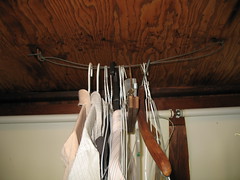 On the back porch hung some old shirts. Ryan spotted one that had “M. Lynwood Smith” handwritten on the inside of the collar. “Look, here’s one that’s been autographed,” said Ryan. Ryan saw some shirts with pretty ragged sleeves. Darrell pointed out how Lynwood would take an old long-sleeved shirt and cut the sleeves off to make a short sleeve work shirt out of it. A few hung on a wire fastened to the ceiling of the back porch.
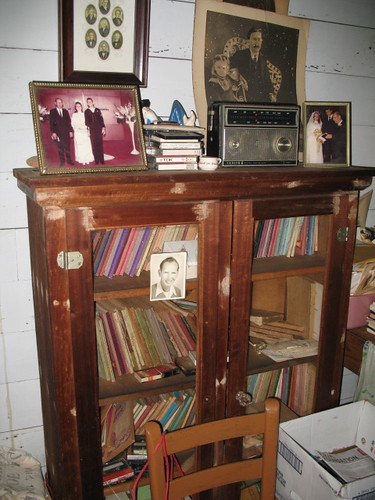
Books and photographs. Quilts on each bed. Old metal beds. A corded phone. A radio. Antique dressers and chests. The old wicker communion table that sat in New Salem’s building back in the 50’s. An old bench style table. A water heater sitting in the open on the back porch.
The house reminded me of one I had visited many times in my youth. The home of Mama Burns, my maternal grandmother’s mother – my great grandmother. A house situated a block away from my grandparents’ house in Ada, Oklahoma.
This was Lynwood’s childhood home. It served him well until his death. One life. One Mississippi community. One house. One church – that he loved. Throughout the house were signs of that love of the Gospel and photographs of “the brethren.”
Simplicity. At every turn I found myself full of envy – of a simpler time, an old home place where a lifetime of memories are centered. My son, my oldest, is now 27. He’s lived in four cities, three states and many houses. I dare not attempt to calculate the places of my life. They’ve been many. Not Lynwood. It was among one of many elements that made him strangely unique, if not eclectic.
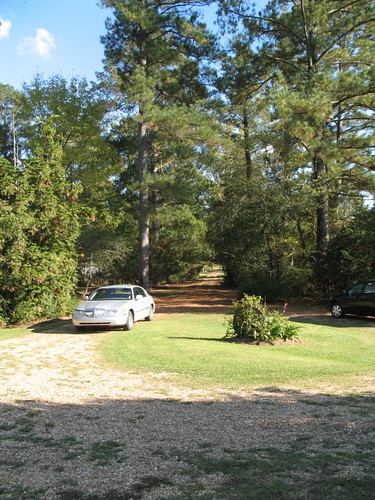
The house was unlike anything Ryan had seen. He’s too young. For me it was nostalgic to see a home like so many I’ve seen through the years of my youth. A place that time forgot. A place full of character, memories and many lifetimes – including the life of a man who had so loved to look down the lane. It is a wonderful view.
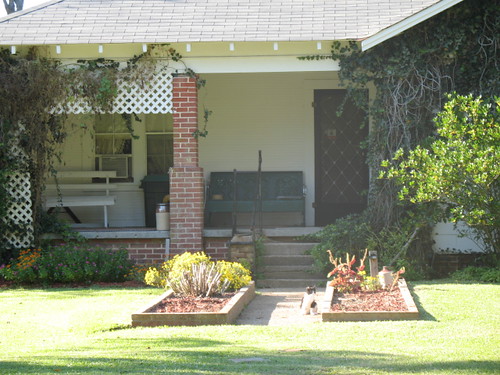 On the porch was a cushion on an old green piece of outdoor furniture. Where the cushion sat was nearest the front door to the house. That was Lynwood’s spot. It gave him the best view of the lane.
A black and white cat nibbled from a bowl on the front porch (you can see him sitting on the sidewalk in the picture), awaiting the old man who kept him company. Diane told us she didn’t know what would become of that cat. I’ll bet he hangs around for a bit wondering when the man is coming home. He’s a cat with no idea that the old man has already gone home.
Click here to see the photographs of the day.
Lynwood Loved The View From Home Read More »
 This post originally appeared at MaxMcAlister.com, a website I created for my first grandson. The site no longer exists.